Lennie’s houseplant
The Sky Is EverywhereLennie’s houseplant is a nondescript indoor plant that Gram has long treated as a barometer of Lennie’s well-being. When its leaves develop black spots during the family’s grief for Bailey, the plant becomes more than a household possession: it gives the family a visible, recurring image for an emotional state that is difficult to address directly. Its later place at the center of a shared joke, and its continued languishing despite attempts to revive it, trace the household’s fragile movement between grief, laughter, and renewed worry.
Identity and Meaning
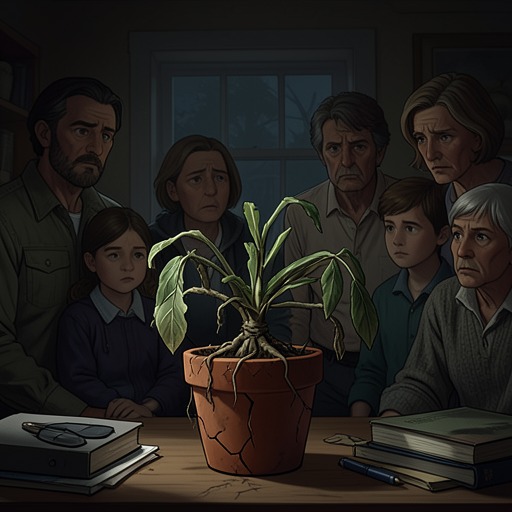
For most of Lennie’s seventeen years, Gram has believed that this particular plant reflects Lennie’s emotional, spiritual, and physical condition. Lennie has come to believe it too. The plant is not identified by species, and its significance rests less on its botanical features than on this shared interpretation: its condition is read as connected to Lennie’s, making its spots matter as more than a gardening problem.
The plant’s deterioration appears while Lennie is grieving Bailey, who died four weeks earlier. Gram is worried not only about the death, but also about the plant’s black-spotted leaves. The pairing makes private distress visible within the household. At the same time, Gram’s concern does not establish that the plant literally causes or controls Lennie’s condition. Rather, the family’s habit of reading it this way gives an ordinary object an intimate role in how they register and talk around her distress.
That role carries an understated irony because Gram is known in Clover as a gardening authority. She is celebrated for her extraordinary flower garden in Northern California, where her roses are renowned for their color and fragrance. Yet this plant seems to follow Lennie’s life independently of Gram’s care or the plant’s own apparent inclinations. The contrast sets Gram’s celebrated ability to nurture flowers against the limits of what she can do for Lennie through tending this one plant.
A Household in Mourning
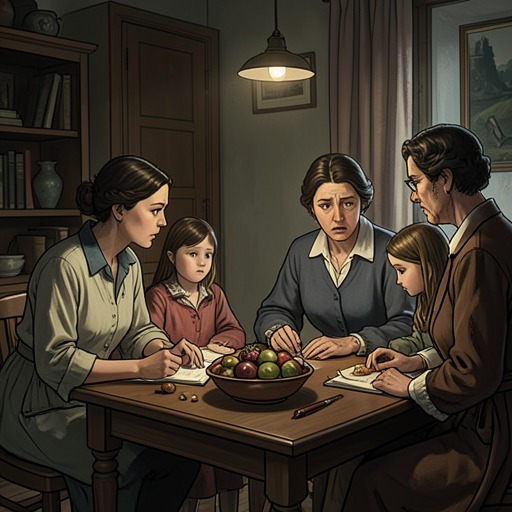
In the early scene centered on the plant, Lennie puts down her book and pen as Gram leans close to the spotted leaves and whispers encouragement about joie de vivre. Gram then sits beside Lennie on the couch; Big joins them, and the three remain together, staring at nothing for the rest of the afternoon. The plant’s condition is part of a broader tableau of stillness: after Bailey’s sudden death from a fatal arrhythmia during rehearsal for a local production of Romeo & Juliet, the family struggles to imagine a future that still feels continuous.
The houseplant’s place in this scene is quiet but consequential. Gram addresses it as if care might reach Lennie through the object, while Lennie’s established belief in their connection makes the gesture legible to her. The scene does not resolve their grief or suggest that the plant can repair it. Instead, the spotted leaves remain in view as a domestic sign of how loss has altered ordinary life, and the family’s shared silence shows the limits of what any of them can say or fix at that moment.
The Plant and a Return of Laughter
When Joe joins the household, the plant again draws attention. He points it out, and the family falls silent, unsure how to explain why Lennie’s plant is being treated as her double. Big breaks the pause with a blunt joke that the plant is Lennie and is dying, while the family cannot work out what to do about it. The humor turns the family’s private association into something they can share in the room without explaining away the grief behind it.
The joke releases an unusually intense bout of laughter from Lennie, Gram, and Big. Big slaps the table; Gram leans against the counter, gasping between laughs; Lennie doubles over, struggling to breathe through her own laughter. They have not had a fit like this in months. Gram’s laughter has a family name, Aunt Gooch, given to it by Bailey and Lennie because it arrived unexpectedly and seemed impossible to send away. Recalling that name ties the present laughter to the sisters’ shared past, even as Bailey’s absence remains central to the moment.
Gram’s astonishment that the laughter might have been gone for good gives the scene its emotional turn. The plant has not recovered, and the family’s grief has not ended; what changes is that laughter briefly returns among them. Its presence can be welcomed without being mistaken for a cure. In this episode, the plant helps make the contrast visible: the same object that has stood beside the family’s sorrow can also anchor an absurd joke and a rare, collective release.
Attempts to Revive It
Joe later proposes a practical-sounding intervention: he puts the plant under one of the household’s pyramids. Big is delighted by the idea and praises Joe’s ingenuity. The moment sits amid another small shift in the household: Gram is beaming after having an idea of her own, and Big and Joe share their excitement while Lennie remains preoccupied with Toby and the previous night. The plant is thus part of the family’s everyday life as well as a symbol; people try things with it, joke about it, and bring it into conversation while their attention moves between different concerns.
The attempted remedy offers no clear recovery. On another day, Big and Joe report that they thought they saw movement in a sixth spider, only to decide it must have been a breeze and that the spider is still dead. Big adds that the Lennie plant is still languishing and considers whether it needs a UV light. The spiders and plant are separate objects, but the exchange places them together in a running household conversation about possible signs of life and failed revival. Its comic tone does not erase the discouragement in the plant’s continued decline.
Narrative Role
Across these episodes, the plant changes function without losing its original association with Lennie. At first, its black spots heighten Gram’s concern in the aftermath of Bailey’s death. Then, when Joe notices it, the family’s comparison of its condition to Lennie’s becomes a joke that enables shared laughter. Later, pyramids and the possibility of a UV light turn the plant into the focus of continued, if uncertain, efforts to help it. These returns keep the image present even when the household’s attention is elsewhere.
The object’s force comes from the tension between its ordinary material presence and the meaning the family gives it. Gram can be an accomplished gardener and still be unable to make this plant flourish; the household can laugh at the comparison and still remain in mourning. The plant does not explain Lennie or stand in for every part of her experience. Instead, the family’s repeated attention to its condition gives grief a small, familiar object around which concern, humor, care, and helplessness can gather.